Explore how tokenization replaces sensitive card data with secure tokens to reduce fraud and streamline PCI compliance for modern businesses.
In 2026, digital payments have become the backbone of modern commerce. From e-commerce checkouts to subscription renewals and UPI-linked cards, billions of transactions happen daily, and so do attempts to steal or misuse payment data.
That’s why payment tokenization has emerged as one of the most powerful shields in the fintech ecosystem. It not only keeps card information safe but also helps merchants boost customer trust, simplify compliance, and improve conversion rates.
Let’s learn what tokenization really means, how it works, and why every merchant, from a startup to an enterprise, should care about it.
What Is Payment Tokenization?
Payment tokenization is the process of replacing sensitive card details, like a 16-digit card number, with a random, unique identifier known as a token.
This token is meaningless outside the system that created it. Even if hackers manage to access it, they can’t reverse-engineer it to reveal the original card number.
Think of it like replacing your house key with a digital copy that only works for one lock and becomes useless anywhere else.
In simple terms, tokenization transforms real payment data into a secure, format-preserving “alias” that allows merchants to process payments safely without ever storing actual card information.
How Payment Tokenization Works (Step-by-Step)
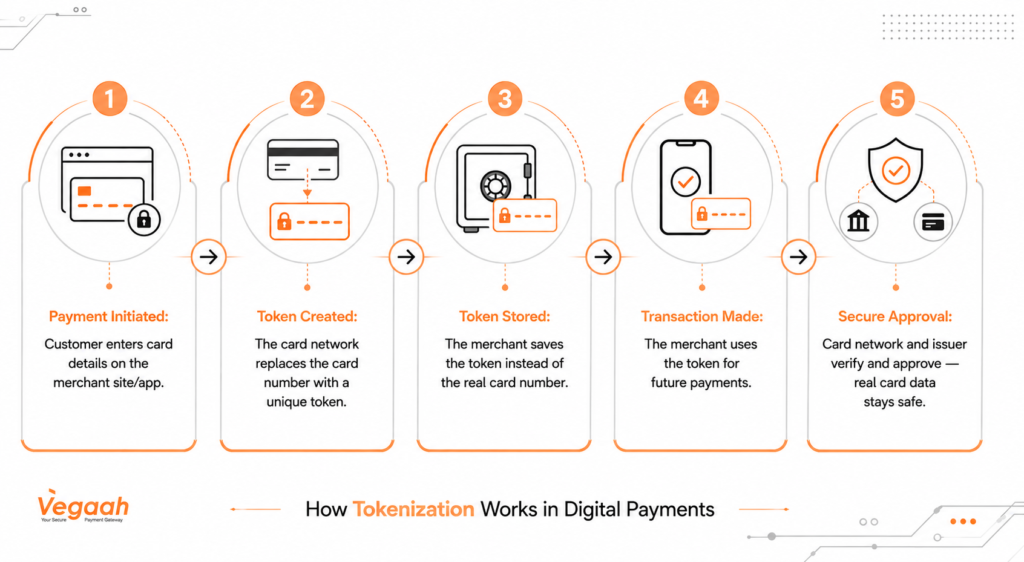
Here’s how a tokenized transaction flows:
- Customer enters card details on a merchant’s website or app.
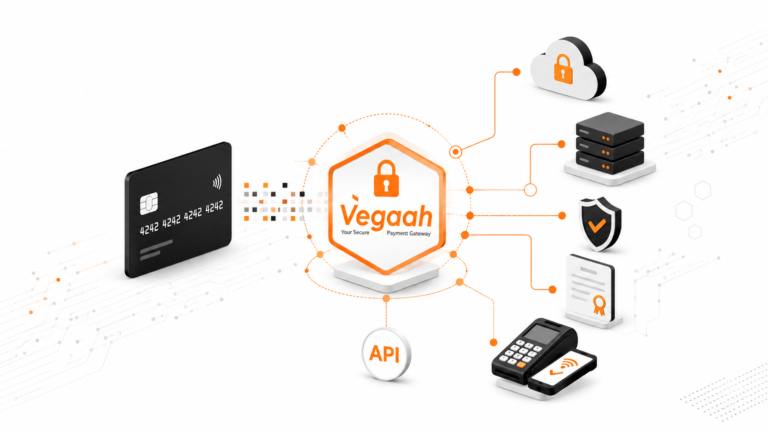
- The card information is securely sent to a Token Service Provider (TSP), often a bank, payment network, or fintech partner like Vegaah.
- The TSP replaces the real card details with a unique token (e.g., 8783-XXXX-3456).
- The merchant stores only this token, never the real card number.
- During future transactions, this token is used to process payments through the card network.
If the token is intercepted, it’s useless to anyone else; it can’t be reused or linked to the original card outside the intended merchant or platform.
Why Merchants Should Care About Tokenization
With the rise of online fraud, evolving regulations, and customer expectations for one-click checkout, tokenization is no longer optional.
Here’s why merchants need it now more than ever — and why understanding tokenization benefits for merchants is key to staying competitive:
1. Enhanced Security and Fraud Prevention
Tokenization drastically reduces the risk of card data theft. Since merchants no longer store sensitive details, even a data breach won’t expose card numbers.
This protection translates into fewer chargebacks, a stronger brand reputation, and peace of mind for both customers and businesses.
2. Simplified PCI DSS Compliance
The Payment Card Industry Data Security Standard (PCI DSS) mandates strict handling of cardholder data. Non-compliance can lead to heavy fines and reputational loss.
Tokenization PCI compliance becomes far simpler: by reducing PCI scope, real card data never touches merchant systems, and the compliance burden drops dramatically.
3. Seamless Customer Experience
Ever wondered how platforms like Netflix, Swiggy, or Amazon let you “save your card” securely? That’s tokenization at work.
It enables faster checkouts, secure recurring payments, and cross-device continuity, leading to fewer cart abandonments and higher conversions.
4. Global Expansion and Multi-Channel Support
Tokenization also helps merchants operate safely across multiple markets and platforms. Whether you’re accepting payments on web, app, or POS, tokens ensure the same security standard everywhere.
Modern networks like Visa, Mastercard, and RuPay now offer network tokenization, which enables interoperability across devices and countries.
Tokenization vs. Encryption: What’s the Difference?
| Aspect | Tokenization | Encryption |
| What it does | Replaces card data with a random token | Encodes data mathematically |
| Reversibility | Non-reversible | Reversible with a key |
| Storage | No sensitive data stored | Encrypted data is still stored |
| PCI Compliance | Reduces scope | Still requires data protection |
| Best for | Payments, recurring billing | Securing data at rest |
In short, encryption protects data in motion or at rest, while tokenization eliminates sensitive data from the merchant environment.
RBI’s Tokenization Mandate: Raising the Security Bar in India
In India, the Reserve Bank of India (RBI) made card-on-file tokenization mandatory for all merchants from 1 October 2022 onward.
That means merchants and payment aggregators can no longer store actual card numbers; only tokens generated by banks or networks can be used.
This move has not only strengthened consumer trust but also reduced instances of card misuse in recurring and subscription payments.
| Aspect | Before RBI 2022 | After RBI 2022 (Tokenization Mandate) |
| Card Storage | Merchants and payment aggregators could store actual card numbers (PAN) for convenience and recurring payments. | Merchants cannot store card numbers. Only card networks and issuers can. Merchants must use tokens instead. |
| Payment Method | Card details are entered directly and saved for future use. | Card details are converted into a unique token for each card–device–merchant combination. |
| Security Level | High risk of card data exposure or misuse if merchant systems were compromised. | Enhanced security — actual card details are never exposed during transactions. |
| Recurring Payments | Based on stored card data or manual re-entry. | Based on tokenized data, users re-enter their card information once, and then future transactions use the token. |
| Customer Experience | Quicker checkouts but higher data vulnerability. | Slightly longer initial setup (first tokenization), but safer and smoother future payments. |
| Compliance Responsibility | Merchants and payment aggregators had to secure card data (PCI-DSS). | Responsibility shifts — merchants use tokens; card networks handle token mapping and security. |
How Tokenization Benefits Different Business Models
- E-commerce & Retail: Protects card data, builds trust, and enables saved-card checkouts for repeat customers.
- Subscription Platforms: Ensures frictionless renewals and compliant storage of recurring billing tokens.
- Fintechs & Aggregators: Simplifies integration with card networks and acquirers through a standardized tokenization API and token APIs.
- SaaS & Marketplaces: Reduces PCI overhead and risk across multi-merchant platforms.
Common Use Cases for Tokenization
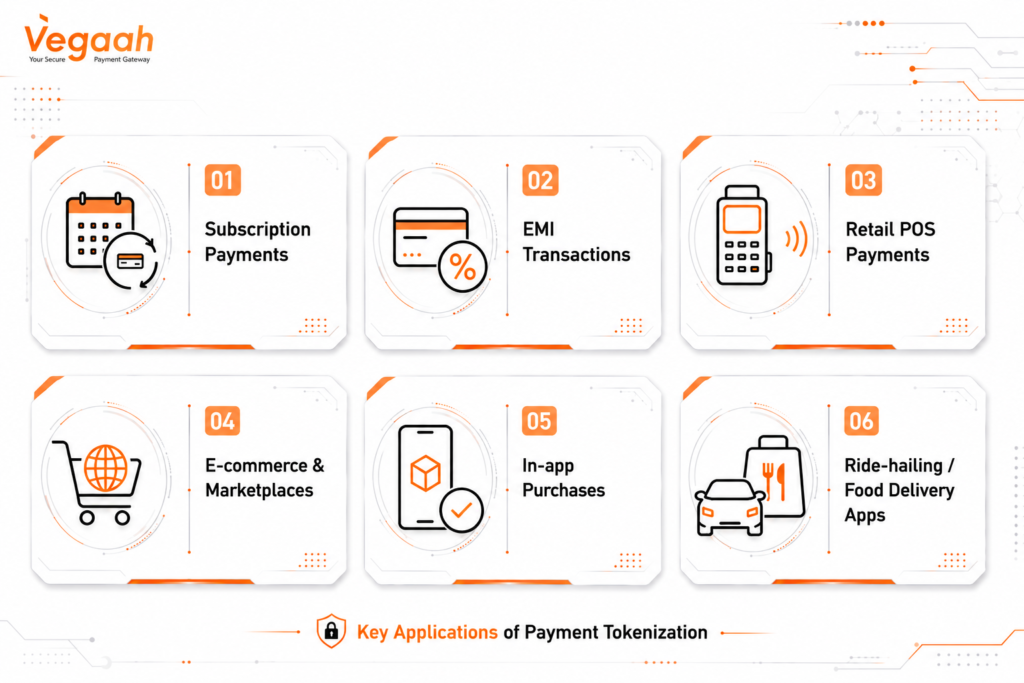
Here are common use cases for payment tokenization,
- EMI Transactions:
- Securely store card details for EMI conversion or recurring monthly deductions.
- Securely store card details for EMI conversion or recurring monthly deductions.
- Subscription Payments:
- Seamless recurring billing for OTT, gym memberships, or SaaS services.
- Tokens enable automatic renewals without re-entering card details.
- Retail POS Payments:
- Contactless or card-on-file transactions at physical stores via
mobile wallet tokenization
(like Google Pay, Apple Pay).
- Contactless or card-on-file transactions at physical stores via
- E-commerce & Marketplaces:
- Safely store customer card tokens for faster checkout across multiple sellers.
- Safely store customer card tokens for faster checkout across multiple sellers.
- In-app Purchases:
- Enable smooth, secure one-click payments within mobile apps.
- Enable smooth, secure one-click payments within mobile apps.
- Ride-hailing / Food Delivery Apps:
- Use tokens for repeated, low-friction payments after the first setup.
The Future of Payment Tokenization (2026 and Beyond)
Tokenization is evolving rapidly. Here’s what’s coming next:
- Dynamic & network tokens: Tokens that refresh periodically for even higher security.
- AI-driven fraud prevention: Combining tokenization with behavioral analytics to flag anomalies in real time.
- Omnichannel tokens: Single customer tokens working across online, in-store, and mobile wallets.
- Expansion beyond cards: Tokenization will soon cover BNPL, digital wallets, and even bank account data (Account Tokenization).
As payments move toward interoperability and instant processing, tokenization will become the invisible fabric connecting security, speed, and convenience.
In a digital-first economy, trust is the new currency, and tokenization is how you earn it. By removing sensitive data from your systems, you reduce risk, simplify compliance, and deliver smoother experiences that keep customers coming back.
Whether you’re scaling globally or managing subscriptions locally, payment tokenization isn’t just a security upgrade; it’s a growth strategy. Knowing how to implement tokenization in e-commerce is now a foundational skill for every merchant.
VegaaH supports secure card tokenization and express checkout features to help merchants safeguard card data while enabling seamless repeat payments.
With Vegaah, merchants can integrate tokenized payments easily, comply with global and local regulations, and future-proof their entire payment infrastructure, all through a secure API.
FAQs
What is payment tokenization in simple terms?
Payment tokenization is a security process that replaces your real card number with a unique digital token, protecting your data during transactions.
How does payment tokenization work for merchants?
When a customer enters card details, the payment provider generates a random token that replaces the real card data. Merchants store and use this token for future transactions, keeping sensitive data safe.
Is payment tokenization mandatory in India?
Yes. As per the RBI mandate, merchants and payment aggregators cannot store card numbers. Only tokenized data generated by authorized networks or banks can be used.
What are the benefits of payment tokenization?
Tokenization reduces fraud, simplifies PCI DSS compliance, and enables secure recurring or saved-card payments, improving both security and customer experience.
Can tokenization be used for recurring or subscription payments?
Absolutely. Tokenization enables merchants to charge customers securely without re-entering card details, ideal for subscriptions and automatic renewals.
Does tokenization affect payment speed or user experience?
No. Tokenized transactions are processed instantly, often improving checkout speed and customer confidence by reducing friction and perceived risk.