In a country long dominated by cash transactions, the Unified Payments Interface (UPI) emerged as a game-changer. A seamless, instant, mobile-first payment system that links multiple bank accounts through a single app and makes fund transfer as simple as sending a text message. Let’s explore UPI and how UPI works in this article.
UPI was launched in 2016 and has since rapidly transformed India’s digital payment ecosystem. It is shifting everyday transactions from peer-to-peer transfers to merchant payments onto a fast, interoperable infrastructure.
The growth has been nothing short of staggering. As of August 2025, UPI processed over 20 billion transactions in a single month, with a total value exceeding ₹24.85 lakh crore (~₹24.85 trillion). (Sources: NPCI)
In September 2025 alone, daily UPI transactions averaged around 654 million.
UPI is no longer a niche offering; it is the backbone of India’s digital payments universe. But with all this speed and scale, a natural question arises- what exactly happens behind the scenes when you tap ‘Pay’? Let’s find out.
What is UPI?
Unified Payments Interface (UPI) is a real-time payment system developed by the National Payments Corporation of India (NPCI). It enables instant money transfers between bank accounts through a mobile device. The UPI full form, Unified Payments Interface, reflects exactly this: one interface, every bank, instant transfers.
At its core, UPI allows users to link multiple bank accounts to a single mobile application and send or receive money using simple identifiers like:
- UPI ID (Virtual Payment Address) — e.g., name@bank
- Mobile number, or
- QR code
It combines multiple banking features, fund transfers, bill payments, merchant transactions, and even small-value peer-to-peer payments into a single, interoperable platform.
In simple terms:
UPI is the digital handshake between your bank account and the world- fast, secure, and always on.
What Makes UPI Different?
Before UPI, digital payments in India largely relied on card networks, wallets, or bank transfers through systems like NEFT, RTGS, or IMPS.
While these methods served their purpose, they came with limitations, including delays in settlement, limited interoperability, and dependence on intermediaries or wallet balances.
UPI changed the game.
It created a unified, real-time payment layer that connects all banks and payment apps under one interoperable network.
Whether you use any online payment app or your bank’s own app, every UPI transaction flows through the same secure infrastructure built and maintained by the National Payments Corporation of India (NPCI).
Here’s how UPI stands apart:
- Real-Time Transfers: Money moves instantly between accounts, 24×7, 365 days a year.
- Interoperability: A user on any UPI app can send money to any other app or bank with no restrictions.
- Security by Design: Every transaction is authenticated through two factors, your device and your UPI PIN, with data encrypted end-to-end.
- Seamless User Experience: No need to remember bank details or IFSC codes; your UPI ID acts as your digital identity.
The rise of UPI also aligns perfectly with India’s Digital India mission, which envisions a less-cash, more connected economy. Backed by RBI and the Government of India, UPI reflects the country’s push toward inclusive, affordable, and tech-driven financial innovation.
Core Architecture of UPI
Behind every tap of the “Pay” button lies a finely tuned digital ecosystem that connects banks, apps, and national infrastructure, all working together in milliseconds.
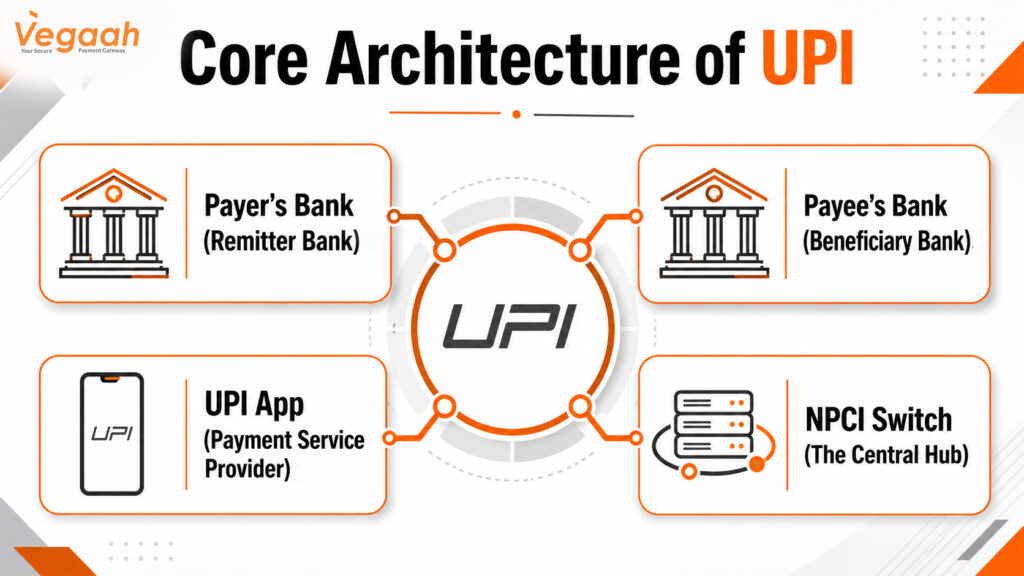
UPI’s architecture is designed to ensure speed, interoperability, and security, no matter which app or bank you use.
Key Entities Involved
- Payer’s Bank (Remitter Bank):
The bank account from which the money is sent. It authenticates the user and debits the requested amount. - Payee’s Bank (Beneficiary Bank):
The bank account that receives the money. It validates the request and credits the amount instantly. - UPI App (Payment Service Provider):
Apps like Google Pay, PhonePe, Paytm, BHIM, and others act as interfaces between users and their banks. These apps initiate, verify, and display transaction updates. - NPCI Switch (The Central Hub):
The National Payments Corporation of India (NPCI) operates the UPI switch, the real-time network that routes transaction data securely between the payer’s and payee’s banks. It ensures the process is standardized, instant, and compliant across all participants.
How UPI Works: Transaction Flow
Behind the successful payment, there is a series of precise digital handshakes happening in real time.
Here’s how UPI works, what actually unfolds the moment you tap “Pay.”
1. Initiation – The Request Begins
You open your UPI app, e.g, Google Pay, and enter the amount or scan the merchant’s QR code. When you tap “Pay,” the app prepares a payment request containing:
- Your UPI ID and bank details (securely tokenized)
- The merchant’s UPI ID or VPA
- The amount and remarks
This data is encrypted and sent to your bank (the Remitter Bank) through the UPI system.
2. Authentication – Verifying It’s Really You
Next, you’re asked to confirm the payment using your UPI PIN. This step ensures two-factor authentication, where your device acts as one factor and your PIN as the second.
Once verified, your bank checks:
- Whether the UPI ID is valid
- Whether your account has a sufficient balance
- Whether the transaction is within the allowed limits
3. Routing – NPCI Takes Over
After your bank approves the transaction, it sends an authorization request to the NPCI UPI Switch.
NPCI acts as a real-time router, securely forwarding this data to the Payee’s Bank (the merchant’s bank).
This routing happens over the IMPS (Immediate Payment Service) rails, the backbone that enables 24×7, real-time interbank settlements.
4. Authorization & Settlement – Money on the Move
The Payee’s Bank receives the request, validates the merchant’s account, and confirms that the amount can be credited.
Once successful, the IMPS network instantly transfers the funds, debits from your account, and credits to the merchant’s account, all within seconds.
NPCI then records this transaction for settlement and reconciliation between banks at the end of the day.
5. Confirmation – Closing the Loop
Finally, both banks send confirmation messages back through NPCI to your UPI app. Within moments, you see “Payment Successful” on your screen, and the merchant’s app receives a credit alert.
All of this happens in under 3 seconds, using secure APIs and encrypted data packets.
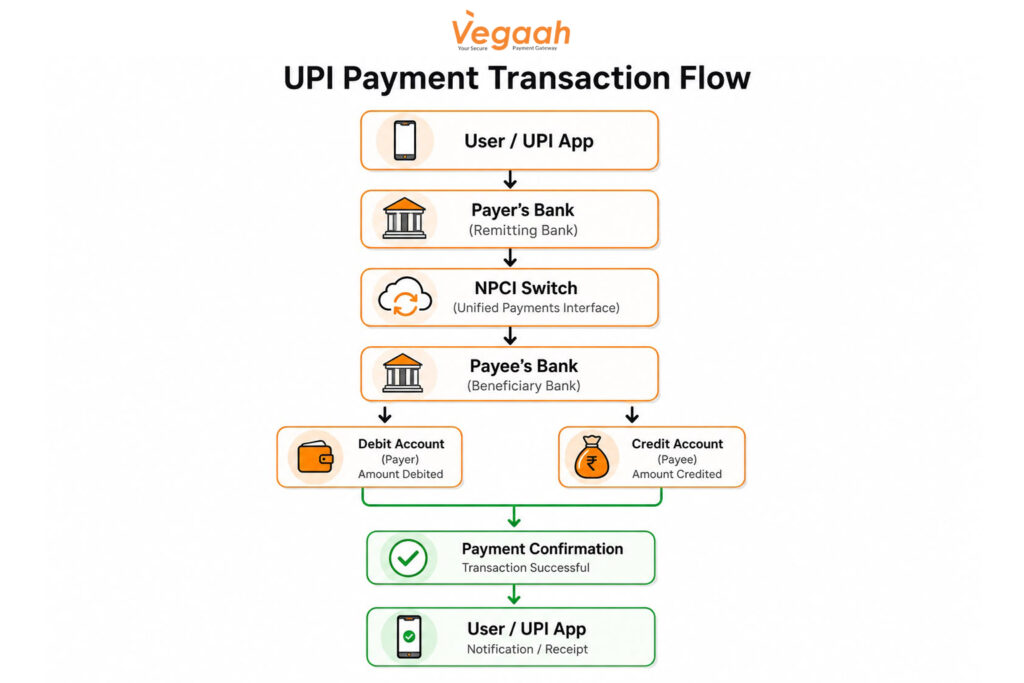
In simple terms, UPI works like a digital courier, securely carrying your payment instructions from your bank to the receiver’s and bringing back instant confirmation.
Security Framework Behind UPI
When billions of rupees move through a mobile screen every day, security isn’t optional; it’s foundational.
UPI’s architecture was designed with multiple layers of protection to ensure every transaction is authenticated, encrypted, and traceable, without compromising user convenience.
Let’s break down what keeps UPI safe behind the scenes
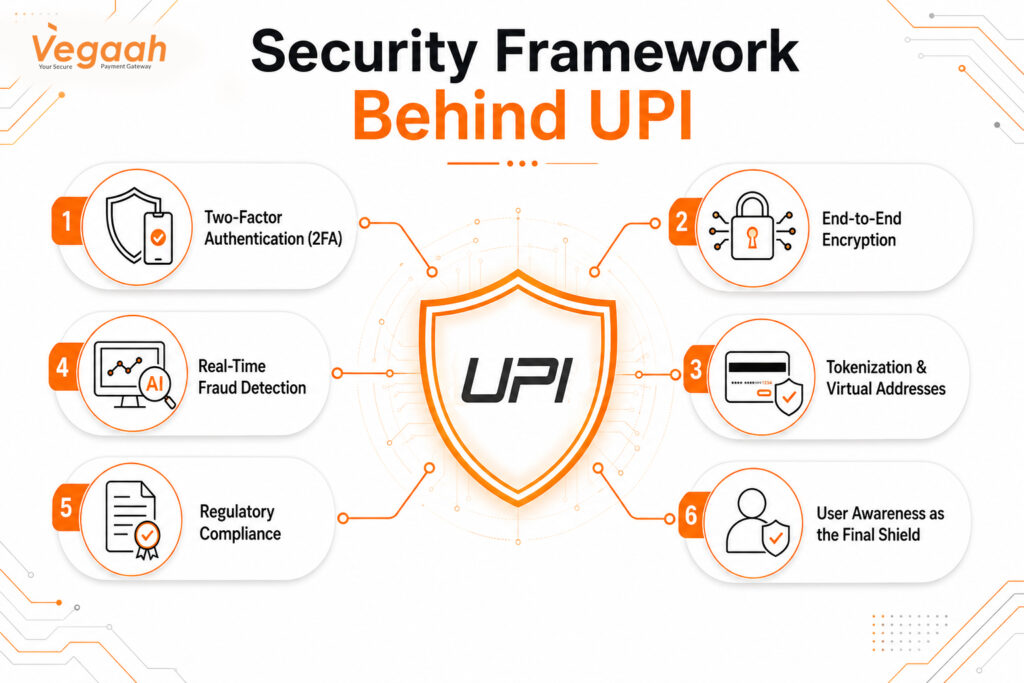
1. Two-Factor Authentication (2FA)
Every UPI transaction must pass two independent checkpoints:
- Device Binding: Your UPI profile is linked to your phone number and device ID, preventing access from unauthorized phones.
- UPI PIN: A confidential 4- or 6-digit PIN known only to you. Even if someone gets your phone, they can’t send money without the PIN.
This dual layer ensures that only the legitimate account holder can authorize payments.
2. End-to-End Encryption
From the moment you hit “Pay” to the final confirmation, all transaction data travels through encrypted channels using advanced cryptographic algorithms.
This means sensitive details, like account numbers, PINs, and UPI IDs, are converted into secure, unreadable code before transmission.
Even payment apps and NPCI never see your actual banking credentials.
3. Tokenization & Virtual Addresses
Instead of sharing your bank details for every transaction, UPI uses Virtual Payment Addresses (VPAs) — like name@bank.
This acts as a token, masking your real account number and minimizing data exposure.
So when you pay a merchant, they only see your UPI ID, not your account or card details.
4. Real-Time Fraud Detection
NPCI and banks continuously monitor transaction patterns using AI-based fraud detection systems.
Suspicious activities like multiple high-value payments, sudden device changes, or location mismatches trigger instant alerts or temporary blocks.
5. Regulatory Compliance
UPI operates under strict supervision from the Reserve Bank of India (RBI) and follows PCI DSS and ISO 27001 standards for data security and privacy.
Regular audits, encryption key rotations, and secure server protocols ensure compliance with India’s most rigorous cybersecurity norms.
6. User Awareness as the Final Shield
While UPI’s technology is robust, user caution remains crucial.
Avoid sharing your UPI PIN, ignore “collect request” scams, and always double-check recipient details before confirming.
UPI’s security framework balances ease and safety, turning complex encryption and authentication processes into something that feels effortless, a tap you can trust.
APIs: The Heart of UPI Innovation
Behind UPI’s speed and simplicity lies one of its greatest strengths, the open API (Application Programming Interface) framework.
These APIs act as digital bridges, allowing apps, banks, and service providers to communicate in real time with unmatched precision and security.
1. How APIs Power UPI
When you make a UPI transaction, dozens of APIs quietly work in the background validating users, checking balances, routing payments, and confirming settlements.
Each UPI app uses these standardized APIs to connect with multiple banks through the NPCI network, ensuring seamless app-to-bank communication regardless of which app or bank you use.
Think of APIs as translators enabling every player in the ecosystem to “speak the same language,” instantly and securely.
2. Fueling Fintech Innovation
UPI’s open architecture has become the foundation of India’s fintech boom.
By exposing standardized APIs, NPCI allows fintech companies and payment service providers to build innovative solutions on top of UPI, from everyday conveniences to advanced financial products.
Some examples include:
- Instant Credit on UPI: Enabling credit lines and small-ticket loans linked directly to UPI.
- Bill Payments & Subscriptions: Automated recurring payments powered by UPI AutoPay.
- Merchant Ecosystems: Unified solutions for online and offline payments with easy reconciliation.
- Cross-Border Expansion: Extending UPI rails to global markets through open API partnerships.
3. Interoperability and Scalability
Unlike closed systems that lock users within specific apps or banks, UPI’s open APIs ensure true interoperability; any UPI app can connect with any bank.
This openness makes UPI infinitely scalable, supporting millions of transactions per minute without bottlenecks or silos.
Why UPI Matters
UPI isn’t just changing how India pays; it’s redefining how the world thinks about digital money.
What began as a tool for instant bank transfers has evolved into a platform for inclusion, innovation, and economic transformation.
1. Driving Financial Inclusion
UPI has opened digital payments to millions who were previously outside the formal banking system.
With just a smartphone and a bank account, anyone can send or receive money instantly, no need for cards, POS machines, or physical banking infrastructure.
This accessibility has empowered small merchants, gig workers, and rural communities, bridging the gap between cash and digital.
From roadside vendors to e-commerce giants, everyone now operates on the same payment rail.
2. Catalyzing the Digital Economy
By offering a secure, low-cost payment infrastructure, UPI has accelerated India’s digital economy.
Businesses can now:
- Accept payments instantly with zero MDR (for most P2P transactions)
- Enable subscription-based services and in-app purchases
- Integrate multiple payment options seamlessly using APIs
This frictionless ecosystem has helped startups and enterprises scale faster while building trust with users through transparent and reliable digital experiences.
3. Going Global
UPI’s success story is now crossing borders.
Countries like Singapore, the UAE, Nepal, France, and Sri Lanka have partnered with India to enable UPI-based payments for cross-border transactions.
Travelers can now use UPI abroad just as easily as they do at home, a step toward making UPI a global digital payment standard.
4. The Road Ahead
The journey is far from over. With innovations like Credit on UPI, Offline UPI, and UPI Lite, the ecosystem continues to evolve. It is bringing faster, smarter, and more inclusive digital experiences to users everywhere.
Benefits of UPI for Merchants
Beyond transforming personal payments, UPI has also become a game-changer for businesses.
Here’s how UPI works for merchants to benefit from this powerful, real-time payment infrastructure
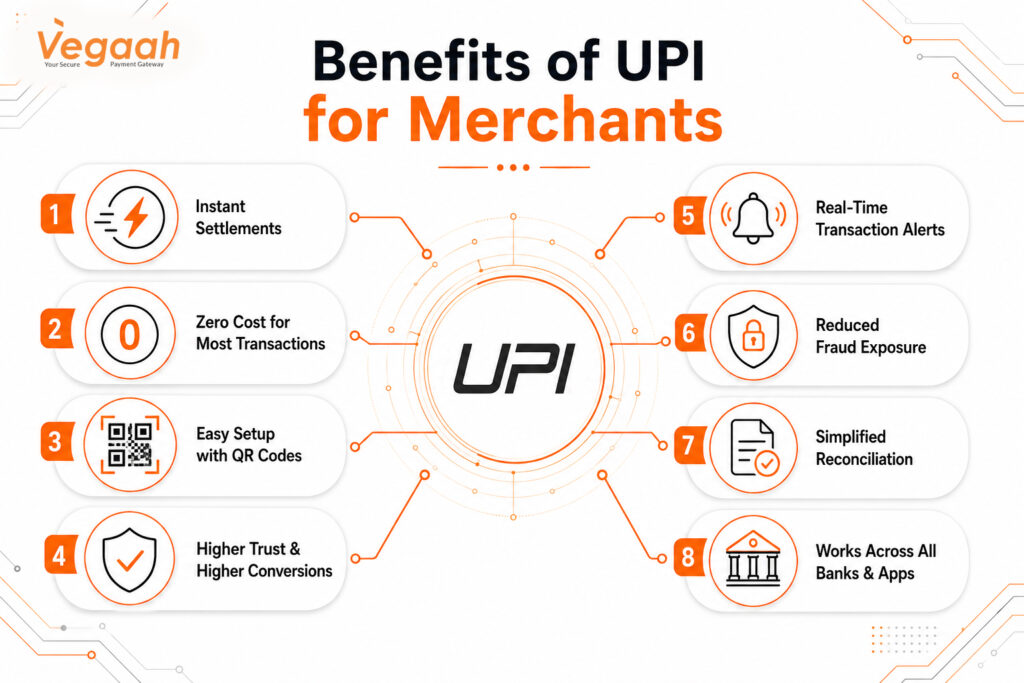
1. Instant Settlements
Merchants receive money directly into their bank accounts within seconds.
No waiting periods, no wallet transfers, no batch settlements. This improves cash flow and daily working capital, especially for small businesses.
2. Zero Cost for Most Transactions
UPI typically comes with zero MDR for P2P and many P2M transactions.
This makes it one of the most cost-efficient payment modes compared to cards or wallets.
3. Easy Setup with QR Codes
UPI requires no POS machines, hardware, or complex integrations.
A simple QR code is enough to start accepting payments, ideal for offline merchants, kiosks, and delivery agents.
4. Higher Trust & Higher Conversions
Customers already trust UPI for daily payments.
UPI’s familiarity and seamless experience reduce checkout friction and boost conversions for online merchants.
5. Real-Time Transaction Alerts
Merchants receive instant confirmation on their apps or dashboards, eliminating disputes about payment status.
6. Reduced Fraud Exposure
UPI’s two-factor authentication, device binding, and encrypted architecture significantly reduce the risks of chargebacks and unauthorized transactions.
7. Simplified Reconciliation
UPI transactions are tagged with clear UTRs and timestamps, making reconciliation faster for both offline and digital businesses.
8. Works Across All Banks & Apps
Merchants don’t depend on any specific app. Customers can pay from any UPI app, ensuring universal acceptance and higher success rates.
As UPI continues to reshape digital commerce, merchants need a partner that delivers reliability, speed, and seamless integration.
With VegaaH, businesses can accept UPI payments effortlessly through secure APIs, real-time settlements, and high-success-rate transactions, making it the smarter choice for every merchant
Challenges and Future Outlook for UPI
UPI’s journey has been extraordinary, but scaling billions of real-time payments comes with new challenges.
1. Scaling the System
With over 20 billion monthly transactions, maintaining speed, uptime, and stability across thousands of banks requires constant infrastructure upgrades and API optimization.
2. Rising Fraud Risks
As the network grows, so do fraud attempts and phishing scams.
Social engineering remains a major vulnerability, not in the system itself, but at the user end.
To counter this, UPI stakeholders, including NPCI and partner banks, are investing in AI-driven fraud detection, real-time risk scoring, and behavioral analytics to identify anomalies before they cause damage.
3. Balancing Regulation and Growth
The zero-MDR policy drives adoption but challenges long-term sustainability for payment providers. A balanced model will be key to future innovation.
UPI has changed the way India pays, turning complex banking steps into simple, instant moments.
As it grows into credit, global payments, and smarter automation, businesses need a partner that can grow with them. Vegaah helps merchants make the most of UPI with faster payments, smarter routing, and easy, secure APIs that work quietly in the background.
With Vegaah, accepting UPI isn’t just effortless; it becomes a powerful driver for smoother operations and faster growth. Connect today to know more.
FAQs
What is the 4-hour rule of UPI?
The 4-hour rule restricts newly added UPI beneficiaries from receiving high-value transfers (usually above ₹2,000) for the first 4 hours. This helps prevent fraud by limiting instant large payments to unverified recipients.
What is the maximum UPI limit for a day?
The daily UPI limit is typically ₹1 lakh per user, though some banks may allow up to ₹2–5 lakh for specific transactions like IPOs or bill payments. Limits can vary based on the bank and UPI app.
What is UPI, and how does it benefit digital payments?
Unified Payments Interface (UPI) is a real-time system that enables instant money transfers between bank accounts via mobile. It simplifies digital payments by offering speed, security, and interoperability across all banks and apps.
Can UPI work without a SIM?
UPI requires a registered SIM card linked to your bank account for authentication. However, UPI Lite and offline UPI options now allow small payments even without an active internet connection, once setup is complete.
What is lightning UPI?
Lightning UPI is an enhanced version of UPI designed for instant, low-latency transactions using advanced infrastructure, enabling faster settlements and smoother high-volume payments, especially for businesses.