Don’t let payment gateway mistakes hurt your business! Discover what to avoid and how to select a secure, seamless gateway for success.
In today’s digital-first world, a payment gateway is the backbone of every online transaction, enabling businesses to accept payments quickly, securely, and seamlessly. Whether you’re running an e-commerce store, a subscription platform, or a service-based business, the right payment gateway can significantly impact your conversion rates and customer trust.
However, choosing the wrong gateway can lead to hidden transaction costs, failed payments, security vulnerabilities, and frustrated customers. A poor payment experience not only disrupts cash flow but can also damage a brand’s reputation and customer loyalty, both of which are critical for growth in a competitive market.
Unfortunately, many businesses overlook key factors when evaluating their options. From ignoring integration compatibility to underestimating security and compliance requirements, these common payment gateway mistakes can have long-term consequences.
In this article, we’ll explore the top errors businesses make while selecting a payment gateway and how you can avoid them to ensure smoother transactions, stronger security, and happier customers.
Common Mistakes Businesses Make while Choosing Payment Gateway
Here is a list of the top mistakes businesses commonly make when selecting a payment gateway.
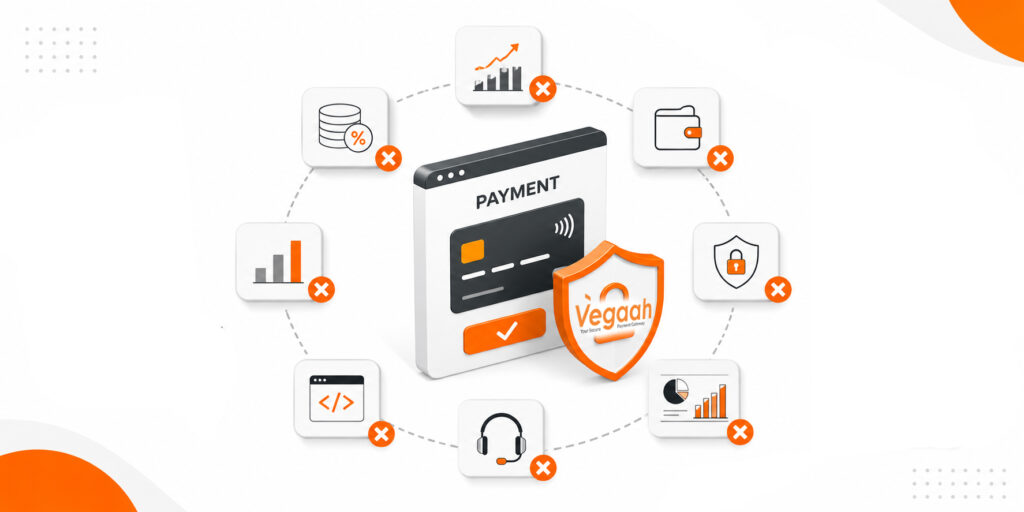
Mistake 1: Ignoring Transaction Fees and Hidden Costs
One of the most common payment gateway selection mistakes businesses make is overlooking the complete cost structure.
While the initial setup or advertised transaction rate may look attractive, many gateways include hidden charges that can quickly eat into profits.
These may include setup fees, monthly maintenance costs, transaction-based commissions, refund or chargeback fees, and even withdrawal charges on settlements.
Startups and SMEs often focus solely on per-transaction fees without assessing how costs scale with growing volumes or multiple payment methods.
Over time, these seemingly minor charges can have a significant impact on revenue and cash flow.
For example, A startup picks a gateway with a 2% fee but later discovers extra ₹5 per refund and ₹500 monthly maintenance, eating into profits.
To avoid this, it is essential to evaluate the total cost of ownership before choosing a gateway.
This means comparing pricing models across providers, understanding fee variations by payment method (cards, UPI, wallets), and checking for any long-term contract clauses or withdrawal limits.
A transparent, predictable pricing structure will not only help control expenses but also ensure sustainable growth as your transaction volumes increase.
Mistake 2: Overlooking Integration and Technical Compatibility
Another major error businesses make while selecting a gateway is ignoring the technical side of integration.
Many payment gateway integration errors occur when APIs, plugins, or SDKs are not fully compatible with the website or app’s existing tech stack. This can lead to failed transactions, delayed settlements, or even downtime, directly affecting user experience and business credibility.
For example, an e-commerce brand faces frequent checkout errors because the gateway’s API doesn’t sync properly with its plugin.
When evaluating a gateway, it’s crucial to check whether it offers seamless integration with popular platforms such as WooCommerce, Magento, or custom-built solutions.
Businesses should also review developer documentation for clarity, flexibility, and ongoing updates.
A sandbox or test environment can be extremely helpful in simulating real transactions before going live, helping identify potential compatibility or performance issues early on.
One of the biggest mistakes when choosing payment gateway solutions is assuming that integration is a one-time task.
In reality, as your business scales or adds new features, ongoing technical support and easy API updates become vital.
Always prioritize gateways that offer strong developer support, detailed documentation, and reliable uptime to ensure smooth, error-free payment processing.
Mistake 3: Limiting Payment Methods
One of the most overlooked mistakes when choosing payment gateway solutions is failing to provide customers with diverse payment options.
Today’s consumers expect flexibility from credit and debit cards to UPI, digital wallets, net banking, and even emerging options like Buy Now Pay Later (BNPL).
For example, A fashion store loses customers during checkout because it doesn’t support UPI, India’s most popular payment mode.
If your gateway doesn’t support the preferred methods of your audience, you risk losing sales at the final step of checkout.
Businesses that limit payment methods often experience higher cart abandonment rates and lower customer satisfaction. For instance, a customer ready to purchase may abandon their order simply because their preferred payment option isn’t available.
When selecting a gateway, evaluate how well it supports multiple currencies, devices, and payment types.
Also, check if it offers regional methods suited to your target market, such as UPI or Paytm in India. The more convenient you make the payment process, the smoother your customer’s journey will be.
Mistake 4: Neglecting Security Measures
In India’s fast-growing digital payment ecosystem, one of the biggest payment gateway security mistakes businesses make is underestimating the importance of security and compliance requirements.
Payment gateways process sensitive information, such as card details, UPI credentials, and personal data, making them prime targets for fraud and cyberattacks.
For example, a merchant suffers a data leak after using a non-PCI-compliant gateway, damaging their reputation and losing customer trust.
Before partnering with a provider, ensure the gateway is PCI-DSS certified, uses SSL encryption, and follows RBI’s tokenization and data localization guidelines.
In addition, look for real-time fraud detection tools, AI-based risk scoring, and two-factor authentication (2FA) to prevent unauthorized transactions, especially for recurring or high-value payments.
A secure payment gateway isn’t just about compliance; in India, it’s a trust signal.
Consumers are increasingly aware of data safety, and one breach can drive them toward competitors.
By choosing a provider that meets both global and Indian regulatory standards, businesses can protect user confidence and sustain long-term growth.
Mistake 5: Ignoring UX Experience
In India, where over 80% of digital transactions now happen on mobile devices, neglecting user experience is one of the costliest payment gateway mistakes.
A slow-loading, non-responsive, or multi-redirect checkout experience often leads to cart abandonment, even when users have strong purchase intent.
For instance, a food delivery app that redirects customers to a slow, lagging external payment page sees a spike in drop-offs, as users lose patience or trust mid-checkout.
Modern Indian consumers expect instant, one-tap, UPI-like experiences.
When selecting a gateway, ensure it supports in-app and mobile-optimized checkouts, UPI intent flows, and smart retries for failed payments.
Seamless authentication using biometrics or OTP auto-read can also improve conversion rates significantly.
A frictionless UX isn’t just about convenience, it’s about trust, speed, and completion.
In a market where users have multiple payment options, every extra second or click can cost a sale. Optimizing for intuitive, mobile-first payment experiences is essential to staying competitive.
Mistake 6: Poor Customer Support and Reliability
Another often underestimated issue in payment gateway selection mistakes is choosing a provider with weak or unresponsive customer support.
Even with the most advanced systems, payment gateway integration errors or technical glitches can arise, from failed transactions to delayed settlements or API issues.
Without timely support, these problems can disrupt your operations and frustrate customers.
For instance, during a festival sale, a gateway faces an issue that goes unresolved for 12 hours. Due to a lack of live support from the gateway team, it costs thousands.
A reliable payment gateway should offer 24/7 technical support, multiple communication channels (chat, email, phone), and dedicated assistance for integration or troubleshooting.
Businesses should also assess how quickly the provider resolves disputes, processes refunds, and handles downtime.
Before signing up, it’s a good idea to review customer feedback and service-level agreements (SLAs) to understand the gateway’s reliability record.
Consistent uptime, transparent communication, and quick issue resolution are key indicators of a trustworthy provider.
In the payments industry, every minute of downtime can translate into lost revenue and customer trust. Prioritizing strong support and system reliability ensures that your transactions remain smooth and your business reputation intact.
Vegaah offers reliable customer support that resolves every issue, keeping your business up and running even in busy seasons.
Mistake 7: Not Planning for Scalability and Future Growth
A common oversight and one of the costliest mistakes when choosing payment gateway solutions is failing to consider future scalability.
Many businesses select a gateway that meets their current needs but struggles to handle higher transaction volumes, new payment methods, or international expansion as the business grows.
As your customer base increases, so does the demand for faster processing, multi-currency support, and integrations with advanced business tools like CRMs or analytics platforms.
A gateway that cannot scale efficiently can limit your growth potential and lead to costly migrations down the line.
For example, a travel startup selected a payment gateway based on its current goals. After a certain time period struggles to expand abroad because its gateway doesn’t support multi-currency payments.
When evaluating options, look for providers that offer flexible APIs, multi-currency capabilities, global payment support, and modular plans that grow with your business.
It’s also wise to consider the provider’s track record in handling high transaction volumes during peak seasons.
Future-proofing your payment infrastructure ensures you’re not just meeting today’s requirements but also preparing for tomorrow’s opportunities, with seamless scalability, reliability, and customer satisfaction at every stage.
Mistake 8: Overlooking Refunds, Disputes, and Chargebacks
One of the less discussed yet critical payment gateway selection mistakes businesses make is neglecting to evaluate how a provider handles refunds, disputes, and chargebacks.
While most companies focus on onboarding and transaction success rates, very few consider what happens when customers request refunds or raise disputes, an area that can significantly affect cash flow and customer trust.
For instance, an electronics brand recently faced social media backlash after customers waited over 10 days for refunds following order cancellations, highlighting how a slow or complex refund process can quickly damage reputation and loyalty.
Similarly, unclear chargeback policies or a lack of transparent communication can lead to financial losses and compliance risks.
Before finalizing a payment gateway, it’s essential to understand how quickly it processes refunds, the fees involved, and how disputes are managed.
Check whether the platform provides detailed reporting and real-time notifications for such events.
Efficient dispute resolution and refund handling are not just about customer satisfaction, they reflect the reliability and maturity of a payment gateway.
By choosing a provider with clear, fair, and automated refund workflows, businesses can maintain trust while minimizing operational hassles.
Here is a summarised chart for clear understanding.
| Mistake | Impact on Business | What to Do Instead |
| 1. Ignoring Transaction Fees and Hidden Costs | Unexpected charges reduce margins and affect cash flow. | Evaluate the total cost of ownership, including setup, maintenance, refund, and withdrawal fees. Choose transparent pricing. |
| 2. Overlooking Integration and Technical Compatibility | Failed transactions and downtime harm customer experience and credibility. | Check API and SDK compatibility, test in sandbox mode, and ensure continuous developer support. |
| 3. Limiting Payment Methods | Higher cart abandonment and lower conversions due to limited options. | Choose a gateway offering diverse payment options, cards, UPI, wallets, BNPL, and multi-currency support. |
| 4. Neglecting Security Measures | Risk of data breaches, fraud, and regulatory non-compliance. | Choose PCI-DSS compliant gateways with SSL encryption, tokenization, fraud detection, and RBI-compliant data handling. |
| 5. Ignoring User Experience (UX) | Poor checkout experience leads to customer frustration and drop-offs. | Ensure mobile-friendly, fast, and intuitive checkout flows with minimal redirects. |
| 6. Poor Customer Support and Reliability | Slow issue resolution and downtime impact revenue and trust. | Partner with providers offering 24/7 support, quick resolution SLAs, and proven uptime. |
| 7. Not Planning for Scalability and Future Growth | Gateway limitations hinder expansion and create costly migrations. | Select scalable solutions with flexible APIs, multi-currency, and global support. |
| 8. Overlooking Refunds, Disputes, and Chargebacks | Inefficient processes frustrate customers and create compliance risks. | Choose gateways with transparent refund timelines, automated workflows, and real-time alerts. |
Selecting the right payment gateway is more than just comparing transaction fees. It’s about ensuring reliability, scalability, and trust across every payment touchpoint.
From hidden costs and poor integrations to limited payment options and weak support, each oversight can affect revenue, user experience, and brand credibility.
That’s where Vegaah makes a difference.
With its secure, transparent pricing and compliance-ready architecture, Vegaah helps businesses avoid these pitfalls.
Our platform ensures seamless integrations, multi-channel payment support, real-time fraud checks, and automated refund management, empowering merchants to scale confidently and deliver a frictionless payment experience.
In an evolving digital payments landscape, Vegaah enables businesses to stay resilient, compliant, and customer-focused, turning payments into a competitive advantage.
Contact today to get started.
FAQs
Why is mobile optimization crucial for payment gateways?
With a significant portion of transactions occurring on mobile devices, an unoptimized payment gateway can lead to poor user experience and increased cart abandonment rates. Ensuring mobile-friendly interfaces is essential for maintaining customer satisfaction.
What does PCI-DSS compliance mean, and why is it important?
PCI-DSS (Payment Card Industry Data Security Standard) compliance ensures that a payment gateway adheres to strict security protocols, protecting customer data and reducing the risk of fraud. Non-compliance can lead to severe penalties and loss of customer trust.
How can I ensure my payment gateway supports multiple payment methods?
When evaluating providers, inquire about their support for various payment options like UPI, credit/debit cards, wallets, and BNPL. A diverse range of payment methods caters to a broader customer base and enhances conversion rates.
What role does customer support play in choosing a payment gateway?
Reliable customer support is vital for addressing issues promptly. Ensure the provider offers 24/7 assistance through multiple channels and has a reputation for resolving problems efficiently.
What should I do if my payment gateway is not performing as expected?
Contact the provider’s support team immediately to diagnose and resolve the issue. If problems persist, consider evaluating alternative providers that better meet your business needs.
What are the most common payment gateway mistakes businesses should avoid?
The most common payment gateway mistakes include ignoring hidden transaction fees, overlooking integration compatibility, limiting payment methods, neglecting security compliance, and failing to plan for scalability. Evaluating these factors upfront helps businesses avoid costly, long-term issues.
How can businesses avoid payment gateway security mistakes?
Choose a PCI-DSS certified gateway with SSL encryption, tokenization, real-time fraud detection, and two-factor authentication. Partnering with a provider that follows RBI’s data localization and compliance guidelines further reduces the risk of fraud and data breaches.