Card-Not-Present payments now fuel a booming e-commerce world: with 2.77 billion global online shoppers and e-commerce accounting for 20% of all retail sales. This makes CNP digital payments the preferred choice of modern customers. Explore more about CNP, how CNP payments work, and how they are going to be the next big thing in payment ecosystems in this article.
The way we pay has evolved far beyond swipes, dips, and chip readers. As online commerce accelerates and everyday transactions migrate to apps, marketplaces, and subscription platforms, digital payments have quietly become the new default.
In this landscape, Card Not Present (CNP) has emerged as a powerful enabler, supporting seamless purchases without the card or the cardholder physically present.
Whether it’s an instant grocery order, a late-night movie subscription, or an international product shipped across borders, CNP payments make it happen.
What once required standing at a counter and tapping a terminal is now completed in seconds through online payments, without friction, without geography, and increasingly, without the need for traditional plastic.
Learn how CNP payments power e-commerce with faster checkout, tokenization, security, and better user experience for digital-first businesses.
What are Card Not Present (CNP) Payments?
At its core, a Card-Not-Present (CNP) payment is any transaction where the cardholder and the physical card are not present during the payment process.
Instead of swiping, tapping, or inserting a card into a POS machine, payments are completed digitally, through apps, websites, or automated recurring billing.
These CNP transactions rely on card details entered remotely, stored securely through tokenization, or passed through encrypted gateways to enable quick and seamless completion.
Unlike traditional in-store purchases, where both the card and customer are physically verified, CNP relies on digital validation layers such as OTPs, tokens, CVV checks, device fingerprinting, or authentication risk scores.
This makes CNP a foundational component of modern commerce, especially as digital and remote payments continue to dominate consumer behaviour.
Real-world Examples of CNP Transactions
You interact with CNP more often than you realize, every time convenience replaces physical presence.
Some everyday scenarios include:
- E-commerce payments made on online stores or marketplaces
- Ordering dinner through food delivery apps like Swiggy or Zomato
- Monthly OTT and subscription payments for Netflix, Spotify, Hotstar, etc.
- Booking flights, hotels, and rentals through online travel booking platforms
From instant buys to automated monthly deductions, these remote payment experiences are frictionless, fast, and woven into how we shop and consume today.
How CNP Payments Work
Even though Card Not Present transactions look simple from the user’s perspective, a lot happens invisibly in the background.
Unlike an in-store swipe, where the card terminal and bank communicate instantly, CNP payments flow through multiple digital checkpoints to ensure authentication, authorization, and secure settlement.
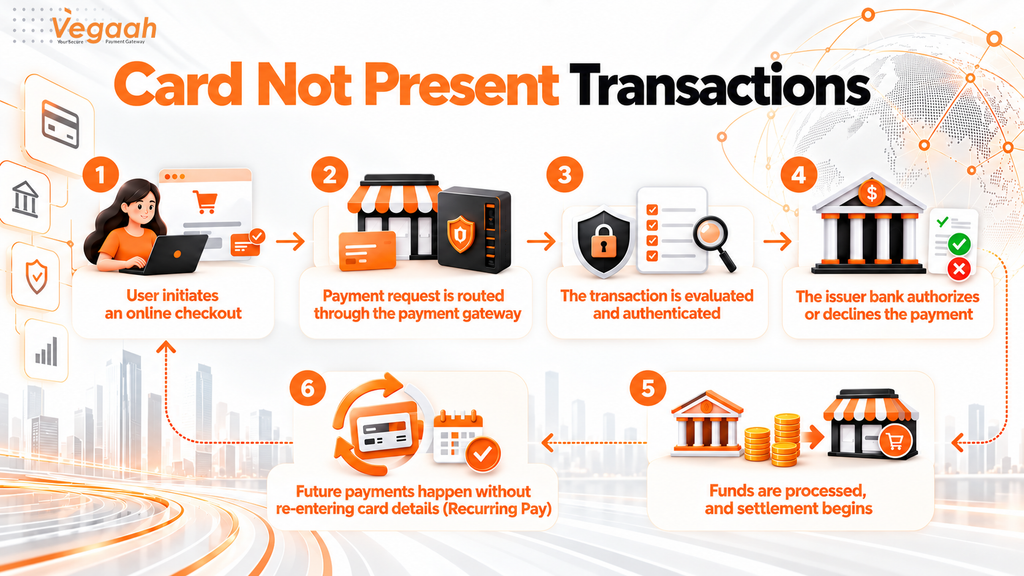
- User initiates an online checkout
The customer enters card details or pays using saved/tokenized credentials on a website or app. - Payment request is routed through the payment gateway
Card details or tokenized data are securely transmitted to the acquiring bank. - The transaction is evaluated and authenticated
Banks may run checks like OTP verification, CVV match, risk scoring, device fingerprinting, and fraud assessment. - The issuer bank authorizes or declines the payment
Based on limits, authenticity, available balance, and risk signals. - Funds are processed, and settlement begins
Once approved, money moves from the cardholder’s bank to the merchant’s account. - Future payments happen without re-entering card details(Recurring Pay
This is possible because tokenization and credentials-on-file enable frictionless repeat transactions.
A single tap is actually a multi-layered digital conversation happening within seconds, validating identity, securing card data, and enabling instant payment completion.
What makes CNP different from card-present swipes & chips
Unlike traditional point-of-sale payments, Card Not Present transactions rely heavily on digital identity and backend intelligence.
Key differences include:
| Key Aspect | Card-Present (Swipe/Chip) | Card-Not-Present (CNP) |
| Physical Verification | Card + cardholder physically present | No physical card or face-to-face validation |
| Reliance on Authentication | Device + chip-based security | Digital signals, behavioural patterns, risk scoring |
| Risk and Fraud Analysis | Minimal physical card reduces risk | Banks assess device, location, IP, behaviour, and session anomalies |
| Data Security Layer | EMV chip encryption | Network tokens replace raw card numbers |
| Checkout Experience | Swipe/tap/dip at the POS terminal | Frictionless Online checkout using stored tokens |
| Speed of Recurring Payments | Needs physical presence each time | Auto-renewal & repeat purchases without re-entering card details |
This shift marks the evolution of payments, from hardware-based verification at terminals to ecosystem-driven authentication built for scale and global commerce.
Why CNP Payments Are Surging in the Digital Economy
The digital economy has transformed the way people buy, pay, and consume.
With smartphones becoming shopping devices, and online retail becoming an everyday habit, Card-Not-Present payments are no longer an exception, they are the default.
The shift from physical POS terminals to digital payments aligns with the way modern consumers behave and the way businesses now operate in a borderless, always-on marketplace.
Growth of E-commerce Payments
Over the past few years, global buying habits have shifted rapidly.
- In 2024, the number of online buyers reached 2.71 billion, and global e-commerce sales are projected to hit US$6.86 trillion in 2025. This surge in online commerce means more e-commerce payments are happening than ever before.
- Online retail now accounts for around 20% of total global retail sales, a number expected to grow further.
- In markets like India, the momentum is even stronger: the domestic e-commerce sector is forecast to grow at 27% annually, with a target of US$163 billion by 2026.
- These numbers show that digital-first shopping is no longer niche; it’s rapidly becoming the norm.
Consumers increasingly prefer convenience over cash.
With saved-card checkouts, mobile ordering, and doorstep delivery, online payments are replacing traditional store visits, fueling not just sales but a broader shift in purchasing behaviour.
Rise of Remote Payments and Mobile-first Behaviour
A large part of today’s purchasing behaviour doesn’t happen at a storefront, it happens on screens.
From ordering food during a commute to booking travel at midnight, consumers value speed and flexibility.
Driving trends:
- Online shopping culture has become mainstream
Remote buying is effortless, available 24×7, and increasingly personalized to user preferences. - Cross-border buying is becoming mainstream
Customers now order from global brands without worrying about geography, enabled by fast settlement and Remote payments.
Together, these shifts are shaping a future where Digital payments are not just an option, they are the backbone of modern commerce.
New Era of Safety: Tokenization and the Shift to Secure Digital Credentials
As digital commerce scales, securing transaction data becomes just as important as enabling seamless checkout.
Traditionally, card details like the PAN, CVV, and expiry were passed directly during a transaction, creating high exposure if intercepted or misused.
Today, payment tokenization is rewriting that rule. Instead of sharing actual card information, sensitive data is converted into randomized, encrypted tokenized payments, making the original card number unreadable and unusable even if intercepted.
This shift is monumental for CNP payments because most of these transactions happen without the physical card or the cardholder present.
Tokenization ensures that even in remote or repeated online transactions, the real card credentials remain protected behind secure digital identifiers, minimizing fraud, reducing data theft, and strengthening trust at scale.
Why Tokenization is Transforming CNP Payments
| Advantage | What it Means for CNP Transactions |
| Safer than storing raw card details | Tokens replace sensitive card numbers, making data breaches significantly less damaging. |
| Works better for card-on-file & recurring billing | Ideal for subscriptions, auto-debits, and one-tap repeat purchases without re-entering card details. |
| Helps build customer trust & faster checkouts | Reduced friction, more confidence, and smoother tokenized payments improve conversion and retention. |
With fraud risks evolving and online commerce expanding globally, tokenization is no longer just an added layer, it is becoming the foundation of CNP payments.
Secure credentials mean faster checkouts, safer transactions, and a payment ecosystem built for longevity, scale, and customer confidence.
What a Good CNP Checkout Experience Looks Like
A seamless CNP flow is not just fast, it’s smart, adaptive, and invisible to the user.
The ideal experience includes:
- Fewer steps, saved cards, one-tap payment
When users don’t need to re-enter details every time, conversion jumps significantly, especially on mobile. - Minimal OTP interruptions (where compliant)
Intelligent risk scoring and token-based authentication allow low-risk transactions to proceed smoothly, while still securing the flow. - Personalized flows based on user behaviour
Returning shoppers can be fast-tracked, while new or high-risk attempts can be routed through enhanced verification.
When checkout feels instant and effortless, customers buy more often, more confidently, and with greater loyalty, proving why UX and speed are now central pillars of CNP evolution.
CNP in E-Commerce: Adoption, Scale & What Comes Next
Card-Not-Present payments are no longer limited to a niche segment of online shoppers, they are embedded into nearly every digital purchase we make.
From ordering groceries at midnight to renewing a streaming subscription while commuting, CNP transactions enable spending without pause, place, or physical presence.
This seamlessness is exactly why CNP adoption in e-commerce continues to accelerate globally.
As e-commerce expands into new categories and customer journeys become more digital-first, convenience-driven payment flows will remain central to user experience and merchant growth.
Factors Driving CNP Adoption in E-Commerce
The rise of CNP payments is strongly tied to the evolution of how consumers shop and how businesses sell online. Key contributors include:
- Marketplace boom
Multi-brand platforms like Amazon, Flipkart, Nykaa, and others thrive on scale, and fast e-commerce payments make buying from them effortless. - Subscription models increasing loyalty
Streaming, SaaS tools, meal plans, and app-based memberships rely heavily on saved card credentials, tokenized billing, and frictionless recurring payments. - On-demand purchases (Insta-buy, 1-click commerce)
With instant checkout, consumers move from browsing → buying in seconds, reducing decision drop-offs and boosting repeat spend.
Together, these forces are shaping a payment ecosystem where CNP is not just convenient, it is foundational.
The more commerce moves online, the faster CNP becomes the default payment rail for the digital economy.
The Future of CNP: Beyond Swipes, Chips & Traditional Cards
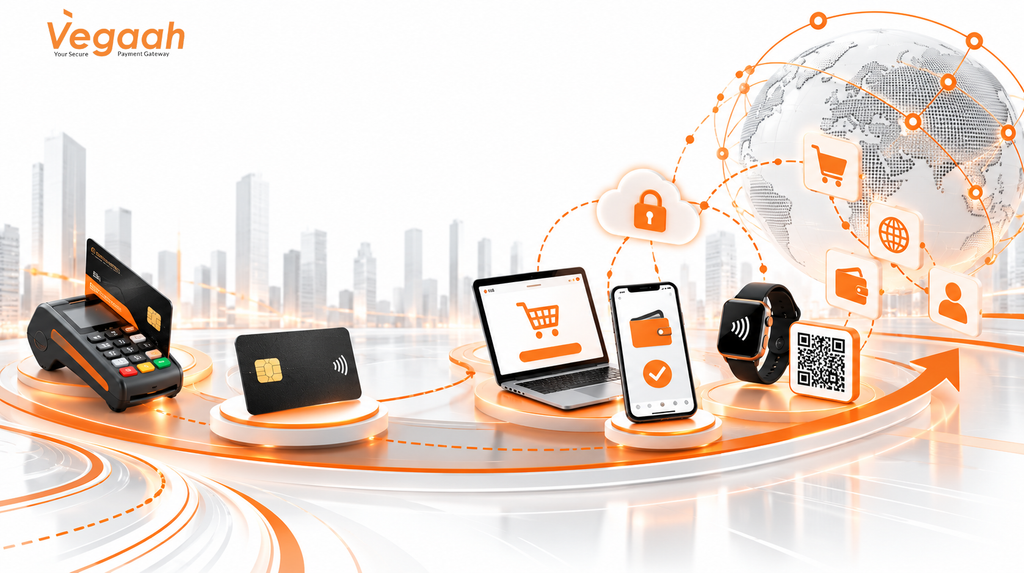
As digital commerce evolves, so will the very foundation of how we transact. The next phase of CNP transactions isn’t just about replacing physical cards, it’s about eliminating friction.
The journey ahead points toward payments that are invisible, instant, and deeply secure, powered by algorithms and identity rather than card numbers and codes.
The future of checkout will be fast, personalized, and almost automatic, aligning perfectly with how modern consumers behave.
What the next decade of CNP innovation may look like
- Network tokens become the new default
Tokenized card data will replace traditional PAN sharing entirely, making digital payments safer and more scalable for global commerce. - Check out without CVV or OTP (risk-based authentication)
Payments will be approved based on trust signals and behavioural patterns instead of manual input fields, speeding up the entire CNP checkout user experience. - Biometrics + behavioural signals replacing manual inputs
Fingerprints, face scans, typing rhythm, and location patterns may validate identity faster than passwords or PINs ever could.
As authentication becomes smarter and risk assessment moves behind the scenes, CNP will no longer feel like a transaction, it will feel like a tap-free, code-free, swipe-free moment of flow.
The world is moving toward payments that happen silently, without disruption or thought, and Card-not-present is paving the way for that future.
Vegaah fits right into this shift, enabling businesses to accept CNP payments with tokenization, fast checkout, advanced authentication, and built-in fraud controls, all designed to boost conversions and customer confidence.
Scale your CNP experience with Vegaah, fast, secure, and built for modern commerce.
What is CNP used for?
CNP is widely used for online shopping, mobile app transactions, subscription billing, recurring payments, in-app purchases, digital services, and remote bookings such as travel or food delivery.
How do CNP payments work?
CNP payments follow a digital flow:
User initiates checkout → payment gateway sends data → issuer validates → bank approves or declines → settlement happens.
Security layers like tokenization, CVV checks, risk scoring, and OTPs help reduce fraud.
Why are CNP payments more common in digital commerce?
CNP payments power online shopping, remote transactions, and subscriptions, making them essential for e-commerce growth. They offer convenience, speed, and the ability to purchase anytime, anywhere.
How does a good CNP checkout experience affect conversions?
A fast, frictionless checkout with saved cards, minimal OTPs, and one-tap payment reduces drop-offs and improves customer loyalty. UX is a major driver of revenue in e-commerce today.
Which industries benefit most from CNP payments?
E-commerce platforms, marketplaces, subscription services, travel apps, food delivery apps, OTT streaming, SaaS platforms, and mobile-first products heavily rely on CNP.